Victoria Falls to Windhoek Overland with G Adventures: 8 Days, the Okavango, and What It Really Costs
Quick answer. Victoria Falls to Windhoek is G Adventures’ 8-day overland through Zimbabwe, Botswana and Namibia: two free days at Victoria Falls, the Chobe River, two nights in the Okavango Delta reached by dugout canoe, the Kalahari, and Windhoek at the end. It’s the cheapest leg of the longer Nairobi to Cape Town route and, day for day, the most packed. Most people book it together with the following two weeks as the 21-day Victoria Falls to Cape Town trip — that’s what the majority of our truck did. We did it in June 2026 as the middle of the full 40 days; the doorless helicopter over the Okavango was our biggest splurge of the whole trip. From about €1,000 per person on sale, €1,350 full price.
Check dates and prices for Delta & Falls Westbound (affiliate link — I earn a small commission at no cost to you)
Victoria Falls is where the long overland changes gear. Our first group had been on the road for twenty days when we rolled into town; about half of them flew home, the rest of us carried on, and a new set of people climbed aboard who’d just landed from Europe with clean clothes and a lot of energy. I’d braced for the changeover feeling like a loss. It was the opposite — suddenly there were people around as excited about day one as we’d been three weeks earlier.
This post is for those people — the ones who start at Victoria Falls. Eight days sounds like a footnote next to the twenty-day legs on either side, but it has the Falls, Chobe and the Okavango in it, and almost everyone who starts here keeps going to Cape Town. So I’ve written it up as the trip you’d actually book: the eight days in detail, how they join onto Namibia, what it costs in euros, what the camping is like, and what I’d tell you before you commit.
The trip in numbers
| Trip | Delta & Falls Westbound: Natural Wonders & Wildlife (G Adventures code DZFO) |
| Duration | 8 days, Victoria Falls → Windhoek |
| Countries | Zimbabwe, Botswana, Namibia |
| Nights | 6 participation camping · 1 basic bush camp in the Okavango Delta (no facilities) |
| Meals included | 6 breakfasts, 6 lunches, 3 dinners |
| Group | Max 22, average 18 — ours was 22 on this leg, the fullest the truck got |
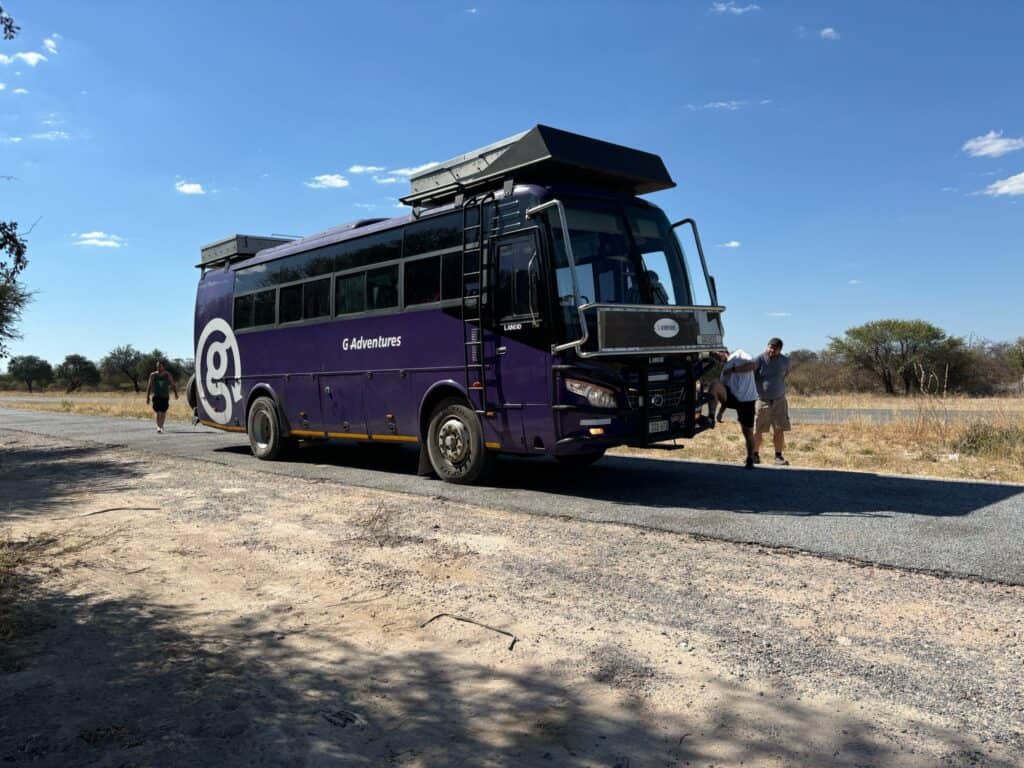
| Transport | The “Lando”, a 24-seat purpose-built overland truck; mokoro dugout canoes and a safari vehicle in the Delta |
| Age range | 18–39 (the all-ages Classic equivalent is “Victoria Falls to Windhoek Overland”, code DZVW) |
| Physical rating | Very easy |
| Price | About €1,350 full price; from about €1,000 on the current 25%-off departures (G Adventures lists US$1,549 / from US$1,162, October 2026) |
| Usually booked as | The 21-day Victoria Falls to Cape Town trip (“Southern Africa Southbound: Dunes, Deltas & Falls”, code DZLD) — this leg plus Windhoek to Cape Town; about €2,525 full, from about €1,960 on sale |
Itinerary and prices from the G Adventures trip pages, checked October 2026; euro figures rounded. Always confirm on the live page.
Which version to book — and why most people book 21 days, not 8
G Adventures sells this stretch three ways, which is confusing until you see the pattern. Delta & Falls Westbound (DZFO) is the 8-day 18–39 trip this post is about. Victoria Falls to Windhoek Overland (DZVW) is the same eight days for all ages. And Southern Africa Southbound: Dunes, Deltas & Falls (DZLD) is the 21-day 18–39 trip that runs these eight days straight into the fourteen through Namibia to Cape Town.
On our truck the eight-day ticket on its own was rare. Of the people who joined at Victoria Falls, nearly all were on the 21-day version to Cape Town; only a few of us were on the full forty from Nairobi. The reason is simple: Windhoek is a fine city but it’s an odd place to end a trip, and the two weeks after it — Etosha, the dunes, Cape Town — are the best two weeks of the whole route. If you can find three weeks rather than one, book the 21 days. If you only have a week, this leg still stands up on its own, and you’ll fly out of Windhoek having seen the Falls, Chobe and the Delta.
See the 21-day Victoria Falls to Cape Town trip
Where this leg sits in the longer route
The full 40-day Nairobi to Cape Town overland is three trips on one ticket: Nairobi to Victoria Falls (20 days), this leg (8 days) and Windhoek to Cape Town (14 days). Victoria Falls is the changeover point, which is why the truck is fullest here — twenty-two on ours. One practical note: Day 1 is an arrival day at Victoria Falls and Day 8 ends in Windhoek, so on the combined tickets this leg shares a day at each end with its neighbours. That’s why 20 + 8 + 14 adds up to more than 40.
If you’re starting here, you’re in good company and nobody has a head start on you: the group that forms at Victoria Falls is a new group, even for the people who’ve come from Nairobi.
Day by day
Day 1 — Victoria Falls. Arrival, a welcome meeting with the CEOs and the group, and drinks at Shearwater Village in the evening. If you’ve just landed, use the evening to finish any visas you haven’t done — our CEO made a point of getting everyone sorted on the first night so nobody held the truck up at a border later.
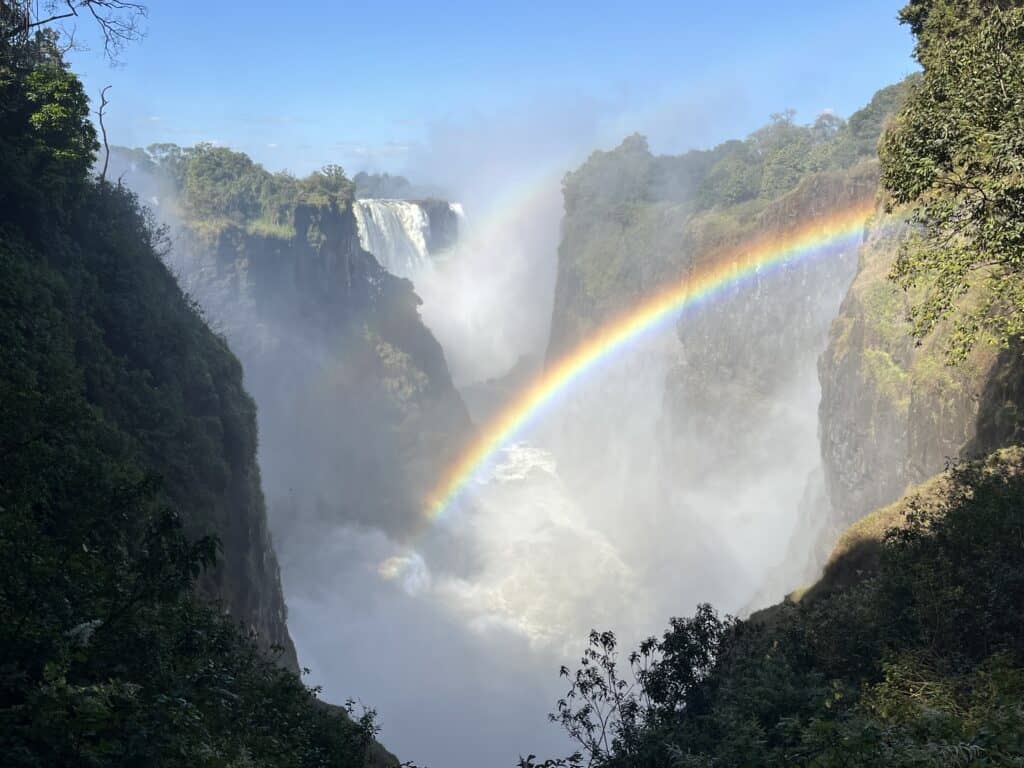
Day 2 — Victoria Falls, free day. This is the one stop on the entire route where the day is properly yours — nobody else’s schedule, just whatever you feel like. For us, arriving after three weeks of early starts, that alone made it a highlight. The Falls themselves are an optional (about €40 to enter) and obviously you go; the double rainbow in the spray is not an exaggeration. We also did the bungee off the bridge (US$145, about €125) — worth every cent, particularly if you’ve never done one. Other options: whitewater rafting (about €105), the 15- or 25-minute helicopter flight (about €140 / €245), a sunset cruise on the Zambezi (about €50).
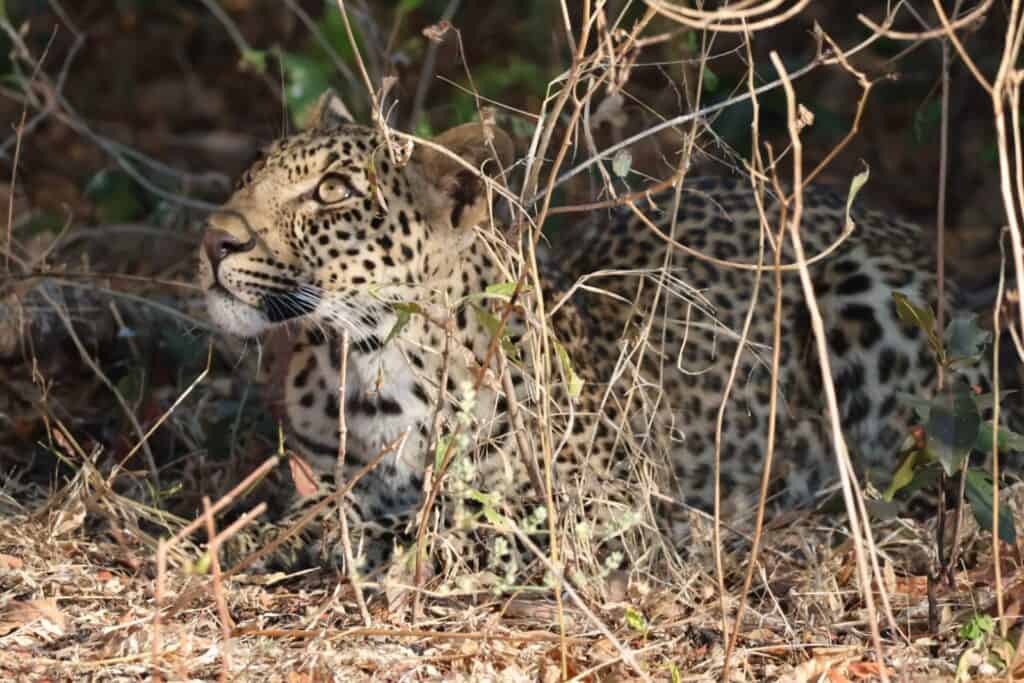
Day 3 — Victoria Falls to Kasane, Botswana. Cross the border and camp beside the Chobe River. The optional sunset river cruise (US$30, about €26) puts you at water level among elephants, hippos and crocodiles — we did it and would again — and there’s an optional game drive into Chobe National Park (about €40) for anyone who hasn’t had enough big game yet. In the dry season Chobe has one of the densest elephant populations anywhere.
Day 4 — Kasane to Nata. South through the grasslands and the edge of the Makgadikgadi salt pans, camping under baobab trees at Nata.
Day 5 — Nata to Maun. On to Maun, the gateway town for the Okavango. The optional doors-off helicopter flight over the Delta leaves from here: US$300 (about €260) per person, so not a casual add-on, and with no doors it is a little scary. It was also one of the most extraordinary things we did in forty days — the Delta from above is a different thing entirely, channels and islands and elephant tracks in a pattern you cannot read from the ground. If the open helicopter puts you off, the Serengeti balloon on the first leg scratches the same itch for the same sort of money.
Day 6 — Into the Okavango Delta. Mokoro dugout canoes, poled by local guides, into the Delta for a night of bush camping with no facilities at all — a wildlife walk, a birdwatching paddle, and hippos grunting somewhere in the dark outside the tent. For many people this is the single best night of the whole overland. It’s included.
Day 7 — Maun to D’kar, the Kalahari. Into the Kalahari for a night at the G Adventures–supported Dqae Qare San camp (G Adventures notes that some departures use nearby accommodation instead), with an optional bushman walk with the San.
Day 8 — D’kar to Windhoek. Cross into Namibia and finish in Windhoek. If you’re flying out, G Adventures asks that your flight leaves no earlier than 20:00. If you’re on the 21-day ticket, the Windhoek to Cape Town leg starts the next morning.
See the full itinerary and current departures
What the 8 days actually cost (in euros)
Here is what this leg cost us, per person, in euros, at the rate we paid.
| Item | Per person (EUR) | Notes |
|---|---|---|
| Tour price | ≈ €1,350 (≈ €1,000 on sale) | DZFO; the 21-day DZLD is ≈ €2,525 / €1,960 |
| Visas | ≈ €112 | US passport: Zimbabwe €26, Namibia €86; Botswana was free |
| Tips | ≈ €50 | €4–7 per person per day for the CEOs, handed over at the end of the leg |
| Food and drink not included | ≈ €80–100 | Only three dinners are included this week — budget more for food than on other legs |
| Campsite upgrades | ≈ €25 | A private room when it’s under about €25 a night; one or two chances on this leg |
| Optional activities | ≈ €450 if you do what we did | Falls entry €40, bungee €125, Chobe cruise €26, Delta helicopter €260 |
| Travel insurance | ≈ €66 | SafetyWing, US$76.28 per four weeks — see below |
| eSIM | ≈ €20 | Airalo, bought country by country |
| Total, no optionals or flights | ≈ €1,700 | ≈ €210 a day; the optionals can add €450 on top |
What’s included: all transport, the Okavango mokoro trip and wildlife walk, the Delta bush camp, the welcome drinks, and most breakfasts and lunches. Not included: Falls entry, every Zambezi and Chobe activity, the helicopter, most dinners, visas, tips and insurance. You can add optionals during the trip — the CEO collects cash a day or two ahead — so you don’t need to decide at booking.
This is where the money goes if you let it. Falls entry, a Zambezi activity, the Chobe cruise and the Delta helicopter can easily total €450–500 per person in a week. None of it is required: the Okavango night is included and alone justifies the leg. Decide in advance what you want. We had the budget and did the lot; you don’t need any of it to have an incredible week.
Insurance. G Adventures makes travel insurance a condition of travel and checks it: you need medical cover with air evacuation and repatriation. We use SafetyWing, the same cover we had when we first moved abroad — about €66 per four weeks, it meets G’s requirement, and you can buy it the day before you fly. (affiliate link)
Visas: lighter than the first leg, but Namibia catches people out
| Country | Visa | Cost per person (US passport) |
|---|---|---|
| Zimbabwe | Single entry, eVisa or on arrival | ≈ €26 (US$30) |
| Botswana | None needed for us | — |
| Namibia | Visa on arrival | ≈ €86 (1,600 NAD) |
Apply online before you fly and print hard copies — some borders insisted on paper, and the queue for people with visas in hand was always shorter. Rules change by nationality; check each official site.
Cash, cards and borders
US dollars are king in Zimbabwe — effectively the local currency — and useful in Botswana. Cards start working again once you cross into Namibia. We each carried about US$500 for the whole forty days and found it was more than we needed; the CEO tells the group before every ATM stop exactly what’s coming up, what it costs and whether it can go on a card, which makes it very easy to manage. For a week on this leg alone, US$200–300 in clean notes plus a card is plenty.
What “participation camping” really means
Six nights are in a tent you pitch and strike yourself, plus the Delta bush camp. The tents are three-person domes shared by two, with room for bags inside, and G Adventures provides a thick sleeping mat; you bring a sleeping bag and pillow.
“Participation” means the group runs the camp. The CEOs split everyone into teams of three or four that rotate through kitchen help, washing up, packing the truck, the cool-box run and a day off. Because it’s organised rather than left to volunteers, everyone pitches in, and the jobs take twenty minutes.
You get used to it fast. Camping was my biggest worry going in and it evaporated within days. The tent goes up in minutes. If you’ve camped on the O Trek in Patagonia or the Tour du Mont Blanc, this is softer — the truck carries everything.
The Delta night is the real thing. No showers, no toilets, no fence — that’s the point. This is the night to have your headlamp, wet wipes and a sense of humour ready. Lions, elephants and hippos do move through; the rule is that animals avoid tents, so keep the door zipped, and if your headlamp catches eyes when you want to go out, don’t.
The upgrade trick. Where campsites offer a private room — roughly €17–85 a night — our rule was that anything under about €25 was an automatic yes. There are fewer chances on this leg than on the others, so take them when they come.
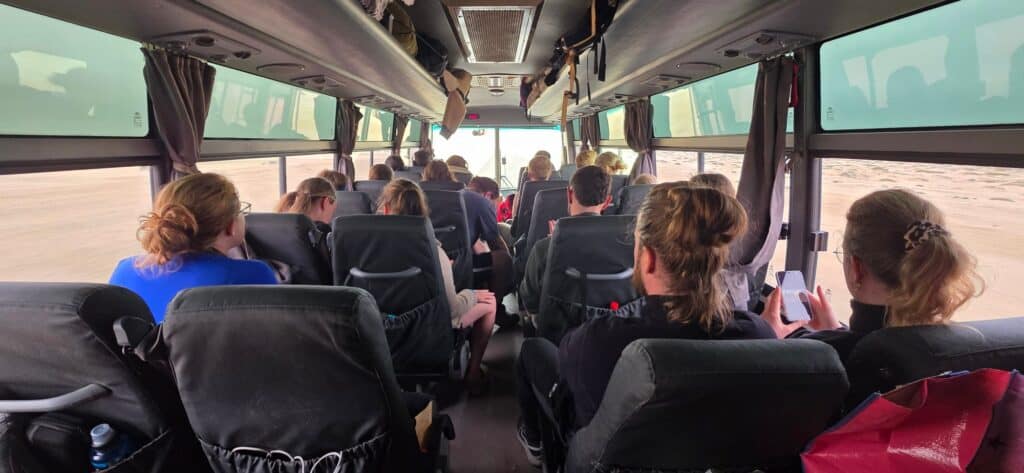
The Lando. A 24-seat purpose-built truck with reclining seats, a kitchen and lockers you reach from inside; USB charging at every seat, no mains sockets, no toilet — roadside stops are a “bushy bushy”. A tank of filtered drinking water on board means no plastic bottles. We rotated seats daily so nobody got stuck at the back. The drives on this leg are the shortest of the route, which after the long hauls from Nairobi felt like a holiday.
Food. The CEO who cooks is the biggest variable on any G Adventures overland; ours was fantastic and we ate healthily, which I hadn’t expected from a camping truck. On this leg, though, only three dinners are included, because so many evenings are at places with a bar and a kitchen — Victoria Falls especially. The truck stops at a supermarket every few days for snacks and drinks at grocery-store prices. Easily vegetarian-friendly.
Who this leg is for — and who should skip it
It’s for you if you have a week (or three), you want the Falls and the Okavango done properly with Chobe and the Kalahari thrown in, and you’re comfortable with simple facilities and one night with none at all.
It’s not for you if you need a private bathroom every night, you want to spend several days in one place, or you’re after a luxury safari — this isn’t that, and the price says so.
Do you need a tour? For this stretch, yes: the Delta is only reachable with guides and the border crossings are far easier on a truck. Book a tour, whichever operator.
As a couple. We loved doing it as a couple. Couples share a tent; solo travellers are paired with someone of the same gender. There’s plenty of room to peel off and have time just the two of you, especially once you reach the campsite — but we got on so well with the group that we spent most meals and free time with everyone anyway.
Solo — and as a solo woman. Same-gender tent pairing means no single supplement. There were many solo women on our truck and not one had any issues. If you’re worried about being alone, you won’t be; the harder thing is finding time to be alone.
Health. Nothing went round our truck beyond a few passing stomach upsets. Several people reacted to their malaria tablets — nausea, mostly — and felt fine within a day of stopping; talk to your doctor about which prophylaxis suits you and start early enough to find out how you tolerate it. Chobe and the Delta are malaria areas, so this is the leg where it matters most.
The honest lowlights
The optional add-ons on this part of the trip can add up quickly. Victoria Falls is a paradise of options but they are all quite expensive. We did the bungee jumping at Victoria Falls and the helicopter tour of the Okavango Delta. Both were incredible.
The least food included. Three dinners in eight days means more eating out and more deciding. Budget for it.
Twenty-two people through one door. This is the leg where the truck is fullest. Wonderful for finding your people; a trial at a border post where every passport goes through one window.
G Adventures vs the other overlanders on this route
| Operator | Style | Age | Notes |
|---|---|---|---|
| G Adventures (DZFO) | Participation camping | 18–39 | The one we took. From ≈ €1,000 on sale. Check price → |
| G Adventures (DZVW) | Participation camping | 12+ | Same route, all ages |
| G Adventures (DZLD) | Participation camping | 18–39 | The 21-day version to Cape Town most people book. Check price → |
| Intrepid | Camping | 15+ | Same quality in our experience, older and calmer group |
| Absolute Africa / Oasis Overland | Camping | 18+ | Cheaper, with less included |
| Acacia Africa | Camping or accommodated | 18+ | Has a no-tent option |
What tipped it for us was how much G Adventures includes — on this leg, the whole Okavango experience is in the base price, where cheaper operators sell it as an add-on. Prices move constantly; check each operator’s own site.
Packing list: what earned its place
Number one: a buff or neck gaiter for the dust in open safari vehicles — we used ours constantly and they were hard to buy en route. The unexpected winner: a deflated football/soccer ball, pumped up on arrival and brought out at every fuel stop, where the locals always joined in. After that: resistance bands (this is forty days of sitting if you’re doing the long route, and even eight days is a lot of truck time); a tablet of downloaded films and audiobooks; a refillable water bottle; a headlamp — essential for the Delta night; a camping inflatable pillow and sleeping-bag liner; noise-cancelling headphones; binoculars for Chobe; a power bank; a Type M plug adapter for Namibia, which most “universal” adapters don’t include; printed visas; and US dollars in clean notes. Leave the drone at home — it’s prohibited in the national parks.
Staying connected: eSIMs work
An Airalo eSIM worked surprisingly well across the whole route, including Botswana where I’d assumed we’d have nothing. Nobody on our truck bothered with physical SIMs. Buy country by country, not the regional Africa plan — the single-country packages were much cheaper, and switching at each border takes a minute. Expect nothing from campsite wifi.
Get an Airalo eSIM for your first country (affiliate link)
Booking tips
Season. We went in June — dry season, cool nights, and the Chobe riverfront at its busiest with game. June to August is the sweet spot; November to March is green, hot and cheaper.
Discounts. G Adventures runs 20–25% sales on specific departures several times a year. Watch the page for a couple of months before committing.
Which ticket. If you have a week: this leg. If you have three: the 21-day Victoria Falls to Cape Town (DZLD) — same start, and it carries you through Etosha, the dunes and into Cape Town, which is a far better place to end than Windhoek. If you have six: the full 40 days from Nairobi, which is cheaper than buying the legs separately.
Check dates, prices and current discounts
Would I do it again?
Yes. Eight days with Victoria Falls at one end and the Okavango in the middle is as good as a week in Africa gets, and it’s the week where the overland format makes the most sense — you simply cannot do the Delta on your own. You’ll spend more than you planned on the optionals and you’ll sleep one night with hippos outside the tent. Trip of a lifetime, even with zero optional activities added — though I’d find the money for the helicopter.
Book Victoria Falls to Windhoek with G Adventures (affiliate link — thank you for supporting the blog)
FAQ
How long is the Victoria Falls to Windhoek overland? Eight days and seven nights with G Adventures, through Zimbabwe, Botswana and Namibia.
Is the Okavango Delta included? Yes — the mokoro trip, the wildlife walk and the night of bush camping are all in the base price. The helicopter flight over it is optional.
Is Victoria Falls entry included? No — about €40, as are all the Zambezi activities.
Which visas do I need? On a US passport: Zimbabwe and Namibia; Botswana was free. Apply online in advance and print them. Check your own nationality.
Can I continue to Cape Town? Yes — and most people do. Book the 21-day Victoria Falls to Cape Town trip (DZLD) instead of this leg alone, or add Windhoek to Cape Town separately.
Is this the middle of the 40-day Nairobi to Cape Town trip? Yes — the full trip is Nairobi to Victoria Falls, this leg, and Windhoek to Cape Town on one ticket.
