Windhoek to Cape Town Overland with G Adventures: 14 Days Through Namibia, and What It Really Costs
Quick answer. Windhoek to Cape Town is G Adventures’ 14-day overland through Namibia and into South Africa: Etosha’s waterholes, Spitzkoppe, Swakopmund, Dune 45 and Sossusvlei, Fish River Canyon, the Orange River, the Cederberg, and Cape Town to finish. Namibia is the country almost everyone on these trucks names as their favourite, and Etosha was the single best night of our forty days. Most people arrive on this leg from Victoria Falls as part of the 21-day trip; a good number book just these two weeks. We did it in June 2026 as the final stretch of the full Nairobi to Cape Town route. From about €1,370 per person on sale, €1,830 full price.
Check dates and prices for Cape & Dunes Southbound (affiliate link — I earn a small commission at no cost to you)
By the time our truck pulled out of Windhoek we had been on the road for twenty-seven days. We had seen the Serengeti, slept in the Okavango, bungee-jumped at Victoria Falls, and I would have told you the best of the trip was behind us. It wasn’t. The last two weeks — Namibia, then the run down to Cape Town — had the best ratio of things-you’ll-never-forget to hours-on-the-truck of the entire route, and if you asked me which leg to pick if you can only do one, this is it.
This post is that leg as a standalone trip: the fourteen days in detail, what they cost in euros, what camping on an overland truck is actually like, who it suits, and what I’d tell you before you book. If you’ve read my review of the full 40 days, some of the practical advice will be familiar — it’s here so this guide stands on its own.
The trip in numbers
| Trip | Cape & Dunes Southbound: Desert Camping & Safari Drives (G Adventures code DNDO) |
| Duration | 14 days, Windhoek → Cape Town |
| Countries | Namibia, South Africa |
| Nights | 8 participation camping · 1 permanent tented camp · 1 bush camping (Spitzkoppe) · 2 backpacker guesthouse (Swakopmund) · 1 hostel (Cape Town) |
| Meals included | 12 breakfasts, 11 lunches, 9 dinners |
| Group | Max 22, average 18 |
| Transport | The “Lando”, a 24-seat purpose-built overland truck |
| Age range | 18–39 (the all-ages Classic equivalent is “Namibia to Cape Town Overland”, code DNWC) |
| Physical rating | Very easy — the Dune 45 climb is the one real exertion |
| Price | About €1,830 full price; from about €1,370 on the current 25%-off departures (G Adventures lists US$2,099 / from US$1,574, October 2026) |
| Usually booked as | The 21-day Victoria Falls to Cape Town trip (“Southern Africa Southbound: Dunes, Deltas & Falls”, code DZLD) — Victoria Falls to Windhoek plus this leg; about €2,525 full, from about €1,960 on sale |
Itinerary and prices from the G Adventures trip pages, checked October 2026; euro figures rounded. Always confirm on the live page.
Which version to book
G Adventures sells this stretch three ways. Cape & Dunes Southbound (DNDO) is the 14-day 18–39 trip this post is about. Namibia to Cape Town Overland (DNWC) is the same fourteen days for all ages. And Southern Africa Southbound: Dunes, Deltas & Falls (DZLD) is the 21-day 18–39 trip that starts a week earlier at Victoria Falls and runs through Chobe and the Okavango before joining this route in Windhoek.
Of the people on our truck for this leg, most were on the 21-day ticket from Victoria Falls, a few joined fresh in Windhoek for just these two weeks, and a handful of us were on the full forty from Nairobi. All three work. The 21-day version is the one I’d steer most people to if they have three weeks — the Okavango is the one thing this leg is missing. If you have two weeks and want Namibia done properly with a soft landing in Cape Town, book this one.
As for age: we booked the 18–39 version as a couple in our mid-thirties, worried the truck would be all 22-year-olds. It wasn’t — a real mix of ages, mostly Europeans, lots of solo travellers of both sexes, a few couples. If you’re over 39, or want a calmer group, DNWC is the same trip.
See the 21-day Victoria Falls to Cape Town trip
Where this leg sits in the longer route
The 40-day Nairobi to Cape Town overland is three trips on one ticket: Nairobi to Victoria Falls (20 days), Victoria Falls to Windhoek (8 days), and this one (14 days). Windhoek is the second changeover: a couple of people left, a couple joined, and the group that rolled into Cape Town was mostly the one that had formed at Victoria Falls. If you’re joining fresh in Windhoek you’ll be joining a group that’s been together for a week or three. It worked fine on ours — Namibia is enough of a shared adventure that the group resets quickly — but it’s one small reason to prefer the 21-day ticket if you can.
The other reason to come this way rather than the reverse is the direction. Everyone who has done this route agrees: finish in Cape Town. After weeks on a truck you will be craving a few days on your own schedule, and Cape Town is the perfect place for exactly that.
Day by day
Day 1 — Windhoek. Arrival day, a welcome meeting with the CEOs and the group, and a night out in Windhoek. Sort your Namibia visa before you land — see below — and your sleeping bag: G Adventures doesn’t rent them, and the desert is cold at night in winter.
Day 2 — Windhoek to the Waterberg Plateau. North out of the city, with a packed lunch from the Penduka women’s project (one of G Adventures’ G for Good partners), to the red sandstone Waterberg Plateau for an afternoon of hiking or the pool.
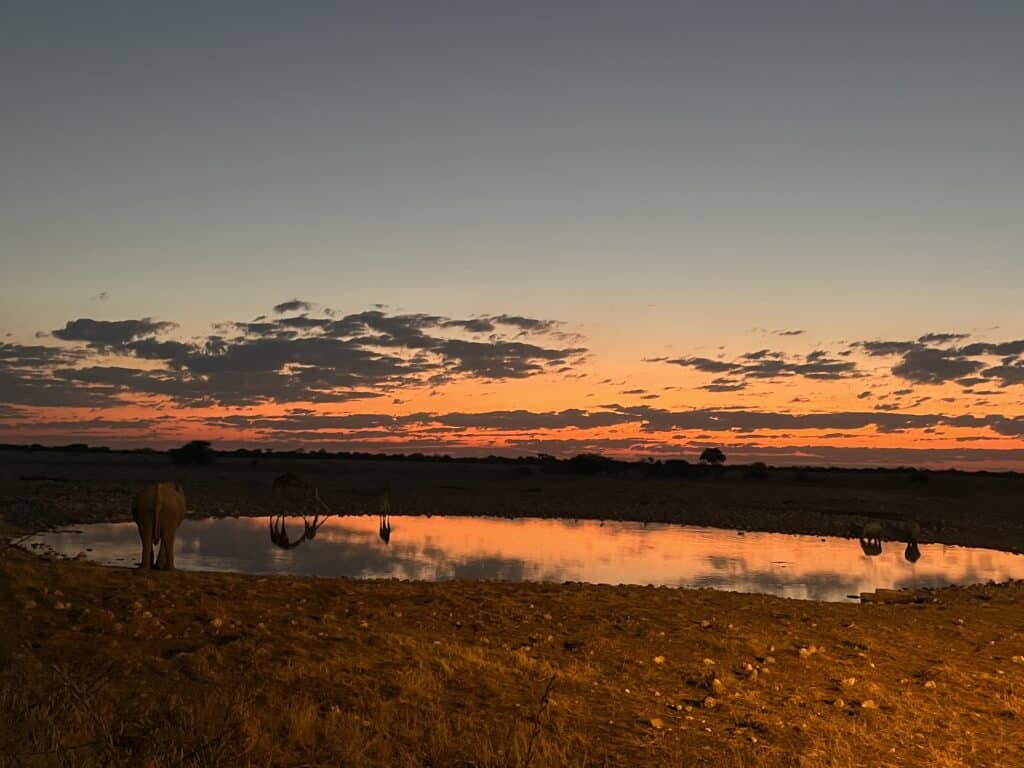
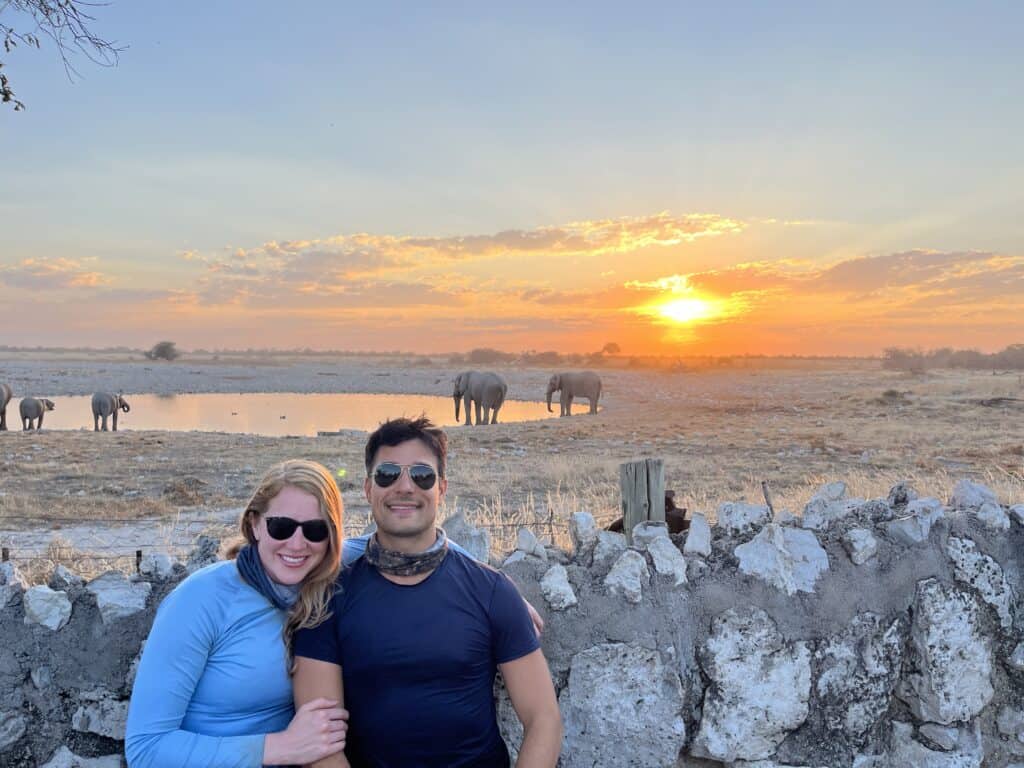
Days 3–4 — Etosha National Park. Two nights inside Etosha with a full day of safari drives in the truck included. This was the best campsite of our entire forty days. The park has very little water, so everything gathers at the waterholes — and there is one right at the camp, floodlit at night. We sat with a glass of wine and watched the sun go down as elephants, giraffes and rhinos drifted in one after another to drink. It was my favourite night of the trip. The one optional I’d call a must is the open-vehicle night drive (750 NAD, about €40): there’s no night safari in the base itinerary anywhere on the route, and the bush after dark is a different place. The open-vehicle day drive (about €65) is also worth it for the lower, closer view.
Day 5 — Spitzkoppe. South to the granite peaks of Spitzkoppe for a night of bush camping under some of the darkest skies you’ll ever see, with the afternoon free to scramble, hike and wait for the stars.
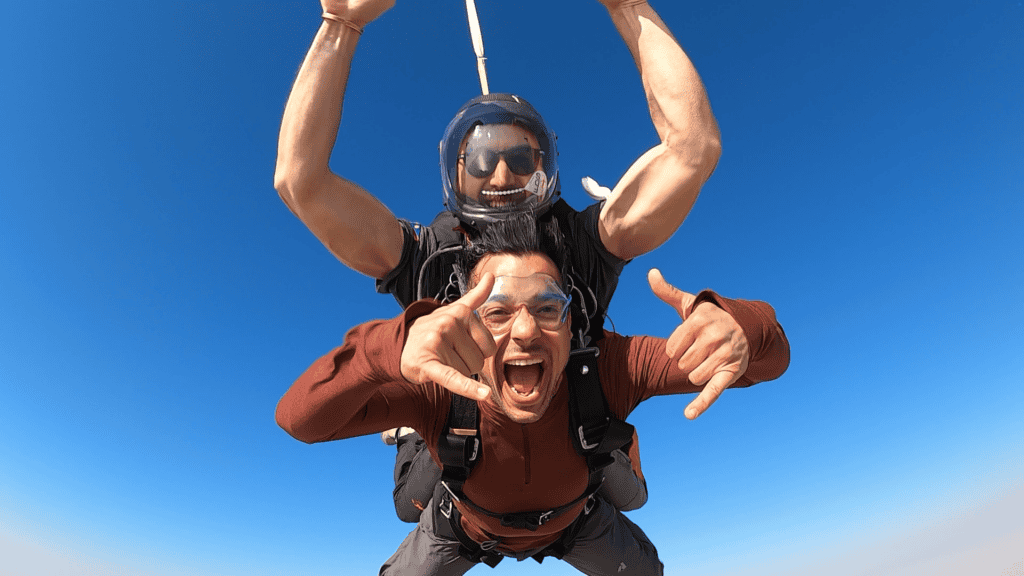
Days 6–7 — Swakopmund. Two nights on the Atlantic coast in a backpacker guesthouse — real beds — with a free day for the adventure menu: sandboarding (about €38), the Skeleton Coast scenic flight (about €255), a township tour (about €40), and skydiving over the dunes where the desert meets the ocean. We did the skydive — 4,900 NAD, about €265 — and it was the thing we’d never planned to do and will never forget.
Day 8 — Swakopmund to the Namib Desert. Inland to camp on the edge of the Namib, with an optional guided desert walk with a local guide (about €21) that is far more interesting than it sounds.
Day 9 — Sesriem, Sossusvlei and Dune 45. The big day: Sesriem Canyon, the dead trees and white clay of Sossusvlei, and the climb up Dune 45 at sunrise — all included. The dune is the one real physical effort of the fortnight; the view from the ridge is the one everyone has as their phone background afterwards.
Day 10 — Fish River Canyon. A long drive south to the second-largest canyon on Earth, arriving for sunset on the rim and a campfire.
Day 11 — Orange River. Cross into South Africa and camp on the Orange River, with optional canoeing (about €21) and the first proper swim in a while.
Day 12 — Cederberg. Through rooibos-tea country to a camp in the Cederberg mountains, with a wine-tasting stop.
Day 13 — Cape Town. Via the !Khwa ttu San Culture and Education Centre at Yzerfontein, another G for Good partner, and into Cape Town for a night in a hostel.
Day 14 — Cape Town. The trip ends after breakfast. Stay on if you possibly can: Table Mountain (cable car about €23, guided hike about €115), the Cape Point day tour (about €95) and a wine tour (about €90) are on G Adventures’ optional list, and the city is the perfect decompression after weeks on a truck.
See the full itinerary and current departures
What the 14 days actually cost (in euros)
Here is what this leg cost us, per person, in euros, at the rate we paid.
| Item | Per person (EUR) | Notes |
|---|---|---|
| Tour price | ≈ €1,830 (≈ €1,370 on sale) | DNDO; the 21-day DZLD is ≈ €2,525 / €1,960 |
| Visas | ≈ €86 | US passport: Namibia 1,600 NAD on arrival; South Africa was free |
| Tips | ≈ €80–100 | €4–7 per person per day for the CEOs, handed over at the end |
| Food and drink not included | ≈ €100–200 | €50–100 a week on supermarket snacks and campsite beers |
| Campsite upgrades | ≈ €25–50 | A private room when it’s under about €25 a night; the guesthouse and hostel nights are already included |
| Optional activities | ≈ €305 if you do what we did | Etosha night drive €40, skydive €265 |
| Travel insurance | ≈ €66 | SafetyWing, US$76.28 per four weeks — see below |
| eSIM | ≈ €30 | Airalo, country by country |
| Total, no optionals or flights | ≈ €2,250 | ≈ €160 a day; the cheapest leg per day |
What’s included: all transport, Etosha park fees and safari drives in the truck, the Waterberg visit, Sossusvlei, Sesriem and Dune 45, Fish River Canyon and Spitzkoppe entrance fees, the !Khwa ttu visit, and most meals. Not included: the open-vehicle Etosha drives, every Swakopmund activity, the Cape Town tours, visas, tips, insurance, drinks and upgrades.
Insurance. G Adventures makes travel insurance a condition of travel and checks it: you need medical cover with air evacuation and repatriation. We use SafetyWing, the same cover we had when we first moved abroad — about €66 per four weeks, it meets G’s requirement, and you can buy it the day before you fly. (affiliate link)
The Namibia visa
On a US passport Namibia charged 1,600 NAD (about €86) on arrival — the single most expensive visa of the whole route, and one that only started applying to many Western passports in 2025, so plenty of people are caught out at the airport or the border. Check the official requirements for your nationality before you fly, apply online if your nationality allows it, and print the confirmation — paper was asked for at more than one border on this route. South Africa was free for us.
Cash and cards
After weeks of US-dollar cash on the earlier legs, Namibia and South Africa are where your card starts working again at shops, restaurants and most activity bookings. Namibia takes South African rand as well as its own dollar (they’re pegged one to one), which saves an exchange at the border. Dollars are still handy for tips and the odd campsite bar. The CEO tells the group before every stop what’s coming up, what it costs and whether it can go on a card, so it’s easy to manage.
What “participation camping” really means
Eight of thirteen nights are in a tent you pitch and strike yourself, plus a night of bush camping at Spitzkoppe and a permanent tented camp. The tents are three-person domes shared by two, with room for bags inside, and G Adventures provides a thick sleeping mat; you bring a sleeping bag and pillow. This is the gentlest leg for camping, with two guesthouse nights in Swakopmund and a hostel in Cape Town breaking it up.
“Participation” means the group runs the camp. The CEOs split everyone into teams of three or four that rotate through kitchen help, washing up, packing the truck, the cool-box run and a day off. Because it’s organised rather than left to volunteers, everyone pitches in, and the jobs take twenty minutes.
You get used to it fast. Camping was my biggest worry going in and it evaporated within days. The tent goes up in minutes, and a sleeping bag under a Namibian sky — Spitzkoppe especially — is one of the reasons you came. If you’ve camped on the O Trek in Patagonia or the Tour du Mont Blanc, this is softer; the truck carries everything.
The upgrade trick. Where campsites offer a private room — roughly €17–85 a night — our rule was that anything under about €25 was an automatic yes. Most of those rooms had a private toilet, which after a week of shared shower blocks is a real luxury.
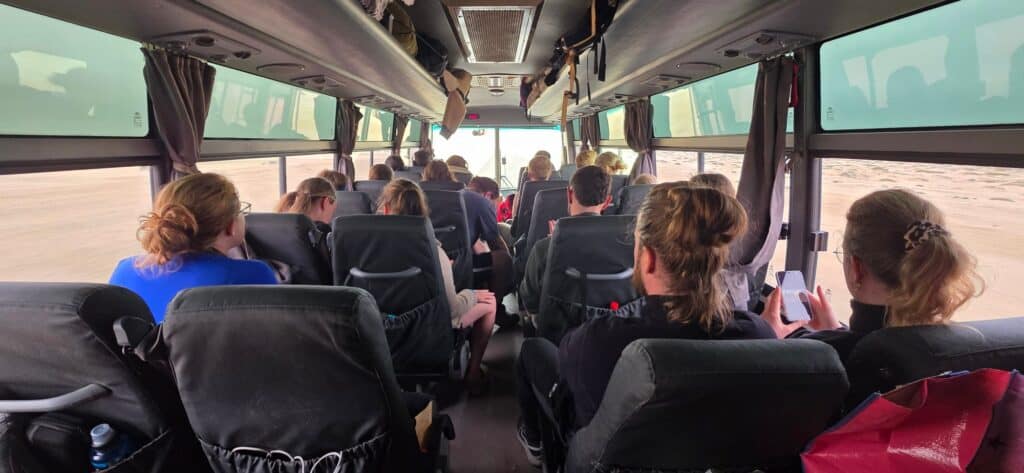
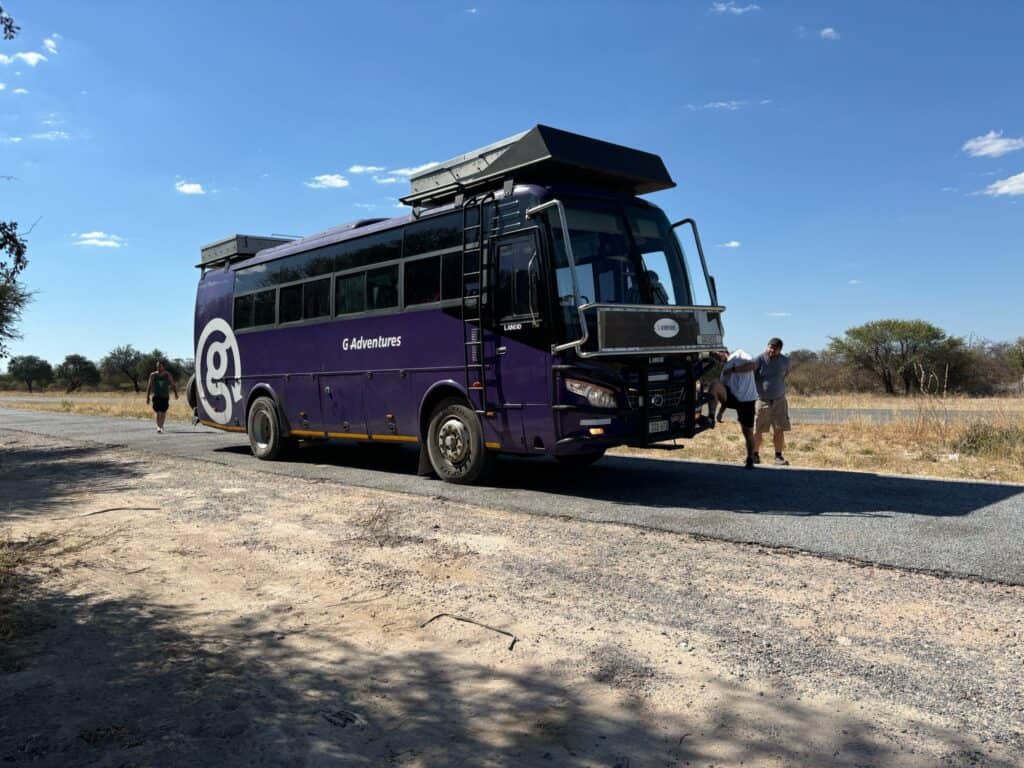
The Lando. A 24-seat purpose-built truck with reclining seats, a kitchen and lockers you reach from inside; USB charging at every seat but no mains sockets and no toilet — roadside stops are a “bushy bushy”. A tank of filtered drinking water on board means no plastic bottles. We rotated seats daily so nobody got stuck at the back; the window on this leg — the Namib, the canyon, the Cederberg — is the reason you’re there. The drives are real (Namibia is enormous and empty) but shorter than the East African legs.
Sitting is still the hard part. Even on the shorter drives, this is a lot of hours in a seat. Bring resistance bands and use them at the campsite; we sometimes got up early to fit exercise in. Dune 45 is the one day your legs get a workout.
Weather. We went in June — winter here: dry, clear, perfect for game viewing, and cold at night in the desert. Pack a proper sleeping bag; the campsites at Spitzkoppe and Sossusvlei get close to freezing. Days are warm and the Atlantic coast at Swakopmund is grey and cool.
Showers. Every campsite has them, and most had hot water. The ones that didn’t were in the middle of extraordinary places where you don’t complain.
Food. The CEO who cooks is the biggest variable; ours was fantastic and we ate healthily. Meals ranged from pasta to braai nights. Supermarket stops every few days at grocery-store prices; easily vegetarian-friendly; a beer at the campsite bar is a euro or two.
Who this leg is for — and who should skip it
It’s for you if you have two weeks, you want Namibia done properly — Etosha, the dunes, the canyon, the coast — and a soft landing in Cape Town at the end. It’s the leg I’d recommend to first-time overlanders: manageable drives, camping broken up by real beds, relentless scenery.
It’s not for you if you need a private bathroom every night, you want to stay in one place, or you’re after a luxury lodge safari — this isn’t that.
Do you need a tour? Namibia is one of the few countries on the route you could self-drive, and plenty of people do. What the truck gives you is zero logistics, a group, and a price per day that a self-drive with park fees and fuel struggles to match. If you want to drive yourself, Namibia is the place to do it; if you want to look out of the window, this is the trip.
As a couple. We loved doing it as a couple. Couples share a tent; solos are paired by gender. Plenty of room for time just the two of you at the campsites, but we spent most meals and free time with the group because we liked them.
Solo — and as a solo woman. Same-gender tent pairing means no single supplement. Many solo women on our truck; none had any issues.
Health. Nothing went round our truck. Etosha is low-risk for malaria in the dry season but not zero; the earlier legs are the higher-risk ones. Several people on our trip reacted to their malaria tablets with nausea and felt fine within a day of stopping — talk to your doctor about what suits you. Pack a first-aid kit; the pharmacy is often a day away.
Wildlife at night. At the Etosha camp the waterhole is right there and animals come to it all night. The rule is the same as everywhere: animals avoid tents, keep the door zipped, and if your headlamp catches eyes, go back inside.
The honest lowlights
It’s still a lot of sitting. Shorter drives than the first leg, but Namibia’s distances are real — the Fish River Canyon day is long — and the lack of exercise gets to active people. Bands, and the Dune 45 climb.
The cold. June nights in the desert surprised people who’d packed for Africa. A proper sleeping bag and a warm layer are not optional.
Windhoek as a start. If you join here rather than at Victoria Falls, your first day is a city with little to do and a group that’s already formed. It resets quickly, but the 21-day ticket avoids it.
G Adventures vs the other overlanders on this route
| Operator | Style | Age | Notes |
|---|---|---|---|
| G Adventures (DNDO) | Participation camping | 18–39 | The one we took. From ≈ €1,370 on sale. Check price → |
| G Adventures (DNWC) | Participation camping | 12+ | Same route, all ages |
| G Adventures (DZLD) | Participation camping | 18–39 | The 21-day version from Victoria Falls most people book. Check price → |
| Intrepid | Camping | 15+ | Same quality in our experience, older and calmer group |
| Absolute Africa / Oasis Overland | Camping | 18+ | Cheaper, with less included |
| Acacia Africa | Camping or accommodated | 18+ | Has a no-tent option |
What tipped it for us was how much G Adventures includes: Etosha, Sossusvlei, Dune 45, Fish River Canyon and Spitzkoppe are all in the base price, so even with zero optionals you get a very full fortnight. Prices move constantly; check each operator’s own site.
Packing list: what earned its place
Number one: a buff or neck gaiter — the Etosha open vehicles and the dunes are dusty, and we used ours constantly. A proper sleeping bag rated for near-freezing nights; G Adventures doesn’t rent them. The unexpected winner: a deflated football, pumped up on arrival and brought out at every fuel stop. After that: resistance bands; a tablet of downloaded films and audiobooks; a refillable water bottle; a headlamp; a camping pillow; noise-cancelling headphones; binoculars for the waterholes; a power bank; a Type M plug adapter for Namibia and South Africa, which most “universal” adapters don’t include; your printed visa; and some US dollars for tips. Leave the drone at home — prohibited in the parks.
Staying connected: eSIMs work
An Airalo eSIM worked well across Namibia and South Africa — in South Africa it was cheaper than a local SIM. Buy country by country, not the regional Africa plan; the single-country packages were much cheaper. Expect nothing from campsite wifi, and nothing at all in the Namib.
Get an Airalo eSIM for your first country (affiliate link)
Booking tips
Season. June was incredible — dry, clear skies at Spitzkoppe, cool game-viewing days in Etosha. June to August is the sweet spot; be ready for cold nights. November to March is hot and cheaper.
Discounts. G Adventures runs 20–25% sales on specific departures several times a year. Watch the page for a couple of months before committing.
Which ticket. Two weeks: this leg. Three weeks: the 21-day Victoria Falls to Cape Town (DZLD), which adds Chobe and the Okavango. Six weeks: the full 40 days from Nairobi, which is cheaper than buying the legs separately.
After the trip. Give yourself at least two or three nights in Cape Town. You will want them.
Check dates, prices and current discounts
Would I do it again?
Without hesitating. If the first leg is the one where you see the animals and the second is the one where you spend the money, this is the one where you sit on a dune at sunrise and wonder why you’d ever travel any other way. Etosha at sunset with a glass of wine and the elephants coming in to drink was the best night of forty, and Cape Town at the end of it was exactly the landing we needed. Trip of a lifetime, even with zero optional activities added — but do the night drive.
Book Windhoek to Cape Town with G Adventures (affiliate link — thank you for supporting the blog)
FAQ
How long is the Windhoek to Cape Town overland? Fourteen days and thirteen nights with G Adventures, through Namibia and into South Africa.
Is Etosha included? Yes — park entry and the safari drives in the truck. The open-vehicle day and night drives are optional extras; do the night drive.
Is Sossusvlei included? Yes — Sesriem Canyon, Sossusvlei and the Dune 45 climb are in the base price.
Do I need a visa for Namibia? Many Western passports now do — on a US passport it was 1,600 NAD, about €86, on arrival. Check the official requirements for your nationality before you fly.
How cold does it get? Near freezing at night in the desert in June–August. Bring a proper sleeping bag.
Should I start in Victoria Falls instead? If you have three weeks, yes — the 21-day Victoria Falls to Cape Town trip adds Chobe and the Okavango and is how most people on our truck did it.
Is this the last part of the 40-day Nairobi to Cape Town trip? Yes — the full trip is Nairobi to Victoria Falls, Victoria Falls to Windhoek and this leg on one ticket.
